How the SAT is structured

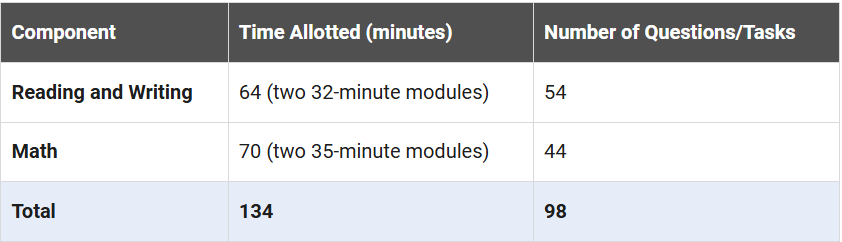
The SAT is composed of two sections: (1) the Reading and Writing section, and (2) the Math section. You have 64 minutes to complete the Reading and Writing section and 70 minutes to complete the Math section for a total of 2 hours and 14 minutes.

Each section is divided into 2 equal length modules, and there is a 10-minute break between the Reading and Writing section and the Math section. The first module of each section contains a broad mix of easy, medium, and hard questions. Based on how you perform on the first module, the second module of questions will either be more difficult or less difficult.

The following table shows how much time you get for each section and the number of questions for each section:
Most of the questions are multiple choice, though some of the math questions ask you to enter the answer rather than select it.

The Reading And Writing Section.

The Reading and Writing section presents short reading passages (or passage pairs) followed by a single multiple-choice question. Questions on the Reading and Writing section represent one of four content domains—Craft and Structure, Information and Ideas, Standard English Conventions, and Expression of Ideas. To help you budget your time, questions that test similar skills and knowledge are grouped together and arranged from easiest to hardest.

The test is divided into 2 modules, each of which includes questions from all four different domains.


What the Reading and Writing Passages Are Like

The questions on the Reading and Writing section fall into four content domains:

1) Information and Ideas 

Measures comprehension, analysis, and reasoning skills and knowledge and the ability to locate, interpret, evaluate, and integrate information and ideas from texts and informational graphics (tables, bar graphs, and line graphs).

2) Craft and Structure

Measures the comprehension, vocabulary, analysis, synthesis, and reasoning skills and knowledge needed to understand and use high-utility words and phrases in context, evaluate texts rhetorically, and make connections between topically related texts.

3) Expression of Ideas

Measures the ability to revise texts to improve the effectiveness of written expression and to meet specific rhetorical goals

4)Standard English Conventions

Measures the ability to edit text to conform to core conventions of Standard English sentence structure, usage, and punctuation.

Math Section: Overwiew

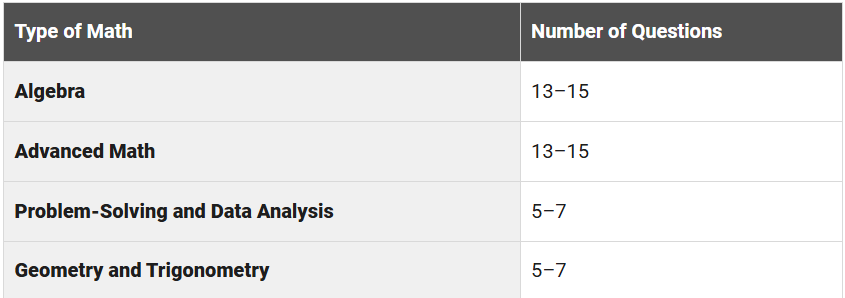
The Math section focuses on the areas of math that play the biggest role in college and career success:

  • Algebra
  • Advanced Math
  • Problem-Solving and Data Analysis
  • Geometry and Trigonometry
Like the Reading and Writing section, the Math section is divided into 2 modules. Over the course of the Math section, you’ll answer multiple-choice and student-produced response questions that measure your fluency with, understanding of, and ability to apply the math concepts, skills, and practices that are most essential.
 
Approximately 30% of Math questions are set in context. These in-context (“word”) questions require you to consider a science, social studies, or real-world scenario and apply your math skills and knowledge, along with an understanding of the context, to determine the answer to each.


Types of Math Tested

The math questions are divided into four categories. Questions from all four categories appear in each test module. Across each module, questions are arranged from easiest to hardest, allowing you to have the best opportunity to demonstrate what you know and can do.